
Each morning, I used to drive to my office and, along the way, drop my children off at their school. It was one of the well-reputed schools in the city, nestled in a scenic sector of Islamabad where the Margalla Hills seem to pause and listen. The air felt different there, quieter perhaps, even indulgent. My children, dressed neatly in their fine uniforms, carried the gentle pride of belonging to such a place. Their school uniforms fitted them perfectly, their shoes polished, their hair combed just so. They took turns sitting with me in the car front seat and the back seat, sometimes absorbed in their favourite books—stories they carried with them, not just for the schoolwork, but for pleasure. In the car, they had a space of their own, a tiny portable world of narratives and imagination. Their branded school bags are carefully placed in the trunk, as if even the bags know their place and weight. On most mornings, we talked. We chatted about things that happened at school, what made them laugh, what confused them, or what a teacher said that stayed with them. These conversations, though ordinary, were always deeply precious for me. These were our sacred rituals of connection—soft, unspectacular moments of sharing that stitch us together.
Then, at a particular turn in the road, I would see them.
And something always shifted in me. Just around the corner from that same scenic streets laid a different school—a provincial government primary school, small and worn, pressed against a crumbling wall that shared its boundary with a garbage dump.
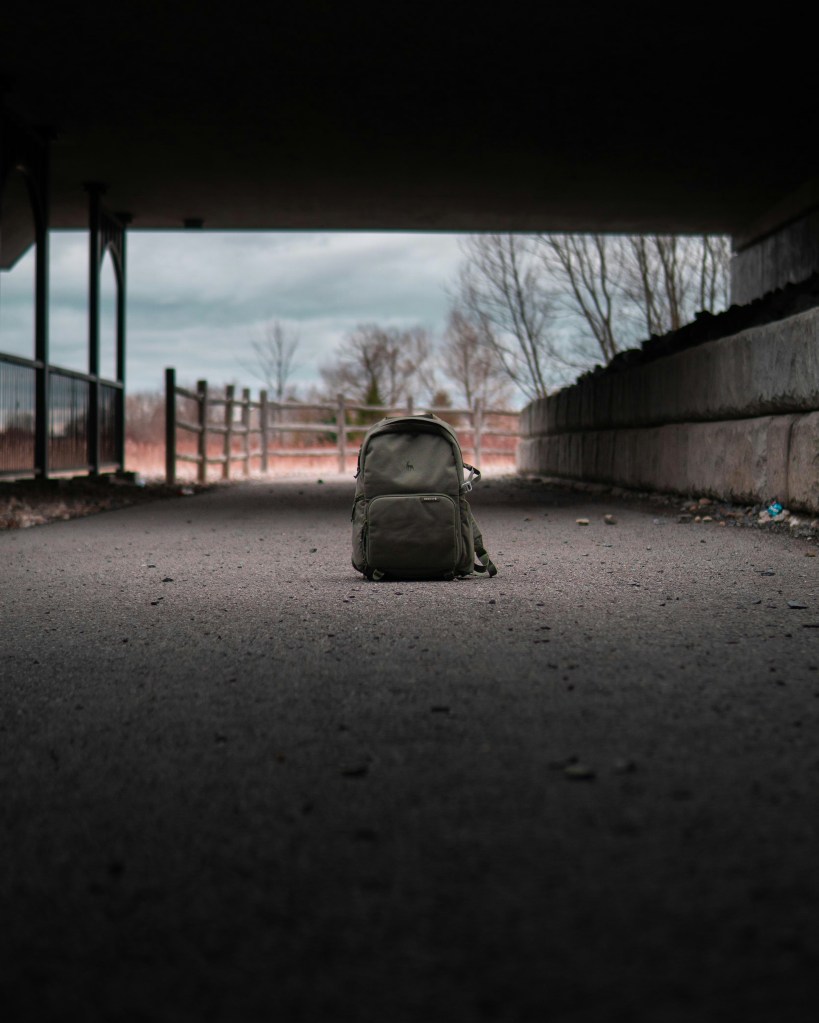
The smell was sharp. The dust was thick. And they were there—seven, maybe eight, sometimes twelve children. They varied in age, in height, and in the way they carried their tiredness. They were all in uniform, but not in the way we understand uniforms. Many wore trousers far too short, exposing their ankles bare without socks. Their shirts were no longer white, but a muted palette of greys and dust. Some uniforms were held together with safety pins or loose stitches. Their school bags sagged with exhaustion—torn at the seams, patched roughly, as if stitched with hope more than thread. Their backs were usually bowed, not by age, but by weight. Books, perhaps. Or expectations that no one had articulated to them. Their shoes—mismatched, worn thin—speak louder than anything else. And still, they walked.
I would glance at my own children, safe in their world of books and neat uniforms. And I often felt something rise in my throat—a pressure, a knot of knowing. It was not guilt. It was something more difficult to name.
A witnessing. A rupture.
There, in that brief stretch of road, two mornings unfold side by side. Two lives, two systems, two imagined futures.
One passed by in an air-conditioned car, the other trudges forward through dust and smell, with dreams perhaps not less vivid, but certainly less permitted.
I would feel my chest tighten. Not out of pity, but because I knew what I was seeing was not new. It was/is ancient. It was/is structural. It was/is built into the very rhythm of this city (and the world may be!).
These two worlds do not collide. They are designed to coexist—silently, side by side—and for the most part, to never acknowledge each other.
But I see them. Every day, I see them. And every day, I carry them with me—the unnamed children with tired feet and shirts that do not fit.
Their presence followed me into meetings, policy papers, and presentations. They stood, silently, in the margins of every education reform conversation I participated in. And sometimes, when I spoke of equity and access, it was not theory I spoke from. It was those moments on the road, when two mornings met and beyond. I was forced to remember that not all journeys to school begin with storybooks in hand and polished shoes. Both mornings exist side by side, spinning in their own orbits, never colliding.
Years passed, and those mornings are as fresh in me as ever. Every time I turn to look at them, a deep sorrow wraps me like a shawl. A sorrow that comes from seeing a system laid bare. A witnessing of what it means to live in a world designed not to care equally.
These two mornings—so close in time, so far in design—do not speak to each other. They exist in the same city, perhaps even the same sector, but they are not meant to touch. And that is the violence. Not the poverty, not even the neglect—but the architecture of silence. The quiet policies that decide who gets the polished desk and who gets the cracked one. Who walks through clean corridors and who walks past open drains. Who is prepared for exams, and who is prepared to endure?
This is not a coincidence. This is not oversight. This is not a failure of individual effort. It is a deeply entrenched system of managed inequality—a Kafkaesque machinery that thrives on processes, committees, and paperwork that promise reform but deliver repetition. Children are fed into it like data points. And some come out with privileges reified, while others come out carrying burdens they never chose.
When I enter policy rooms and speak of equity, it is this bend in the road that haunts my sentences. When I draft documents on inclusion, it is the faces of those children that flicker between the lines. I do not speak from theory—I speak from rupture. I speak from that moment when two worlds looked at each other, wordless, and moved on as they were taught to.
And perhaps the sharpest cruelty lies in that: that we are taught to keep moving. To polish our language, to sanitise our reports, to advocate gently, to ‘understand the constraints.’ But those children walk through constraints. They live them, breathe them. And yet, they arrive.
Each morning, they arrive.
What name do we give to such resilience? And what name do we give to the structures that require it?
What do we call this politics, where care is not absent, but rationed?
Where justice is spoken in mission statements but made unrecognisable in practice?
I carry their image with me—not out of pity, but as a form of responsibility. As a refusal to forget. Because forgetting is how the system survives. Through forgetting, it teaches us to accept. To believe that the road will always have two turns. That some uniforms will always shine, and others will always fray.
But I remember.
Every day, I remember.
And in that remembering, I write.
Because perhaps remembering is the beginning of resistance.
Perhaps witnessing, when it refuses to be silenced, becomes the only care we can offer in a world that pretends care is too costly.
……to be continued.


Leave a Reply