
A handwoven rug becomes more than an heirloom—it becomes a provocation. In this reflection, I explore how educational leadership, like handweaving, emerges from local memory, embodied wisdom, and refusal to forget. It is time to move beyond borrowed frameworks and honour the knowledge we carry in our bones.
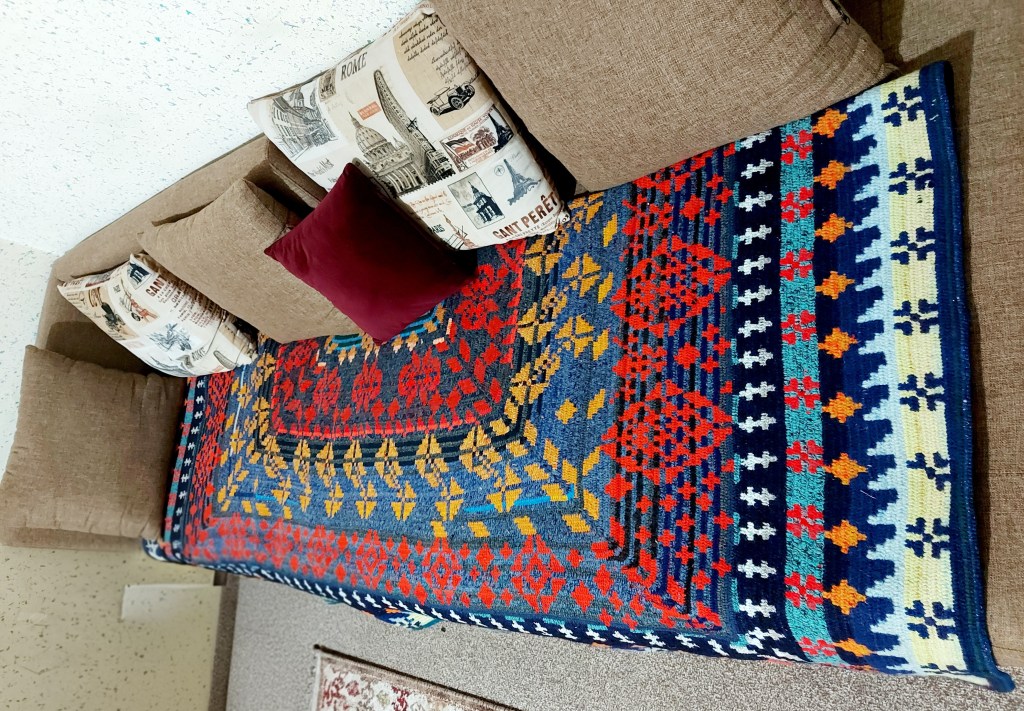
Folded and spread across the worn-out couch in my living room was the colourful rug handwoven by my late grandmother, Amma G.
In childhood, I often watched her knotting strand after strand with a crochet needle that, to my eyes, seemed like a magic wand. I was always amazed to see intricate patterns emerge from the tangled mess of wool balls she carried in a small basket that travelled everywhere with her.
I remember how she would cradle the rug-in-progress in that basket until it grew too large to hold. Then, she would spread it out on the floor and begin circling it, weaving row after row until the pattern felt complete. That was when she’d gift it, always without ceremony, to one of her children.
This one was given to my father, who, for reasons I never fully asked but understood, could never bring himself to lay it on the floor. He kept it folded and stored away, untouched for years, until I quietly claimed it and spread it across my couch. I too couldn’t lay it on the floor. It became part of my room, part of my everyday life, and more significantly, part of my work-from-home world during the COVID-19 lockdowns.
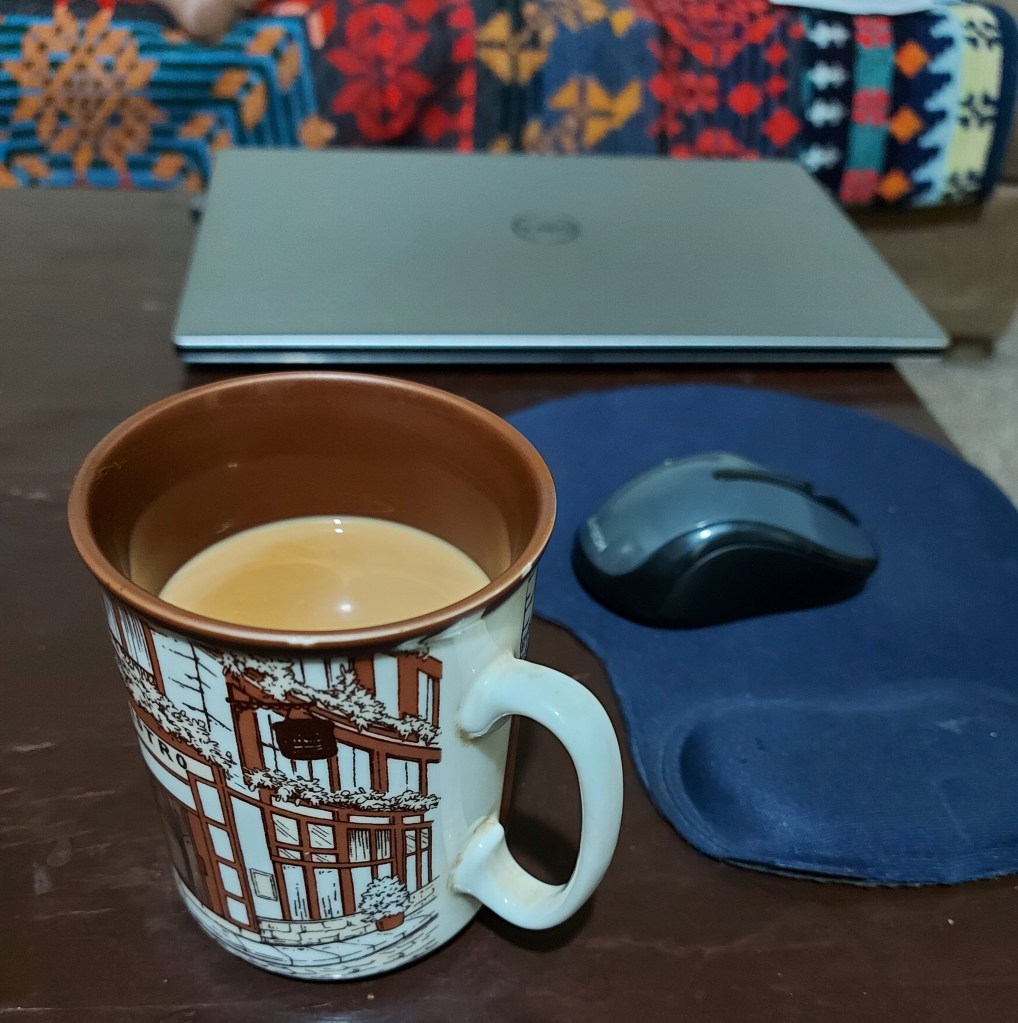
One afternoon, in the midst of yet another work-heavy day, I stepped away from my screen and cradled a cup of tea between my tired hands. My eyes drifted across the room and landed on the rug. That rug. The one my grandmother, Amma G, had woven with her own hands. And suddenly, I found myself standing at the edge of something as deceptively simple as its threads.
Her fingers once danced across this fabric, knotting colours and patterns pulled not just from her imagination, but from something deeper—a memory older than herself. I bent down, letting my palm travel across the coarse yet tender weave, and something stirred. A whisper from history, perhaps.
There was no signature. No date. Yet it spoke. The rug was a story. A map. A vessel of unsaid things.
Each motif held fragments of her life—echoes of the places she had lived, the salt of loss she had tasted, the sun-drenched fields she had worked in beside my grandfather, and the dialects she folded quietly into silence. Her hands, steady and unshaken, borrowed from the centuries of women before her. Women who wove not only to cover floors, but to carry forward what the world is always too hasty to forget. It was her culture and history that weaved the pattern, very unique to its context.
The patterns were distinct, rooted in the land she came from and weaving the collective memory. I believe no two regions weave the same. Every design is a cultural fingerprint. As I traced the shapes, a quiet and unsettling clarity settled in. The rug wasn’t there only to comfort. It was telling long-forgotten stories. It was asking questions.
Why did/do we forget (or were/are made to forget) what we already knew/know?
Why did/do we reach for borrowed ideas to understand who we were/are supposed to be?
And what will it take to return to our own ways of knowing, of remembering, of weaving knowledge that is ours?
In the world of educational leadership, too, we often find ourselves tangled in the same threads. Theories formed in distant institutions, tested in unfamiliar worlds, and polished in journals with high impact and low context are offered as universal truths. They are meant to work anywhere, we’re told. No matter the climate. No matter the contradictions. No matter the histories we carry in our bones. Theories and frameworks carrying an illusion of neatness are imported and implemented: untouched by poverty, patriarchy, colonial residue, or the daily messiness of life in places like mine.
But leadership, like my Amma G’s rug, is woven from what the hand remembers. It is not neat. It is not standardised. It is shaped in the thick weave of daily entanglements—at school gates that open to floodwaters, in classrooms where the heat clings to the walls like a second skin, in corridors where a woman principal’s footsteps sound just a little too loud.
The Moment Theory Failed Me
I remember sitting in my principal’s office one day, a stack of files full of policy letters and documents neatly arranged on one side of the desk, the phone and computer on the other. On the other side of the polished office table sat a father, pleading for his over-aged son’s admission in the school against all odds and with eyes full of hope. And I realised that none of the theories I had studied or policies meant to follow had prepared me for that moment. None had shown me how to lead when my own belonging was uncertain. Leadership wasn’t a ladder. It was a labyrinth. A shifting space of partial entry, delayed recognition, and quiet defiance.
Much like Kafka’s characters, school leaders in marginalised and messy contexts laden with a colonial/feudal/hierarchical history of control are summoned without clarity, judged by metrics they did not choose, and asked to perform roles scripted by others. Their efforts to lead often feel like knocking on one door only to find another behind it. Policies fold into other policies. Promises dissolve the moment they meet the real.
And yet, even in the disorientation, something endures.
Something like the threads in my grandmother’s rug.
A local wisdom.
An embodied ethic.
A refusal to forget.
Educational leadership must not be imposed from above. It must be read, listened to, and felt. It must be held in the hands of those who live it, shaped by the places they serve, and accountable to the communities who walk those school corridors every day. Theories must learn to bend. They must unravel and be rewoven in dialogue with the lifeworlds they claim to guide.
So I return to the rug. Not as an heirloom, but as a provocation.
It reminds me that leadership, at its best, is a handwoven thing. Imperfect. In progress. Yet alive with memory and meaning. It invites us to reimagine leadership not as mastery, but as making. A practice drawn from what we know deep in our bones, shaped by the places we belong to, and passed forward with care to those who will walk after us.
…to be continued.
Comments
9 responses to “Threads in the Labyrinth: Leadership, Legacy, and the Woven Indigenous Wisdom”
-
-
Sam, that’s very encouraging!
LikeLike
-
-
-
Thank you, Rukhsana, for engaging and reflecting.
LikeLike
-
-
Truly impressive and based on hard and bitter realities.
Same feelings run in my blood when a review meeting slide focuses on principal’s results with GPA and %ages.
and I shudder because that’s the very reason many principals don’t give admission to below average students or slow learners.
there should be some different criterias to measure someone’s hardwork, dedication and love for all students regardless of their intelligence, caste, language etc.
-
Rightly said, Robbina. There must be another way of doing things and policies must not lead to exclusion but to include every child equittably. Appeeciate your engagement and reflection.
LikeLike
-
-
-
Yes, Samina. And they bring their own histories and beliefs in their everyday practices, creating their unique tapestries.
LikeLike
-


Published on


 Saadia Adnan
Leave a reply to Robbina Shaheen Cancel reply