

Franz Kafka (1883–1924) offered us the labyrinth not simply as a place of confusion, but as a structure that keeps one walking, turning, and returning, never quite arriving at the centre. In the politics of gender, the labyrinth is often ordinary, and familiar, but taken-for-granted. Its walls are not always built with laws or loud declarations. Sometimes they are built with those mundane routines we rarely notice as extraordinary, like who is served first, whose hunger is answered, and whose needs are quietly postponed. Today’s reflection is shared with gratitude from a colleague’s sharing whose leadership is deeply justice-oriented and grounded in student welfare. They told me this story, and it stayed with me because it captures how gendered injustice can be enacted without spectacle, and yet with lifelong consequences.
Disappearance from Plate
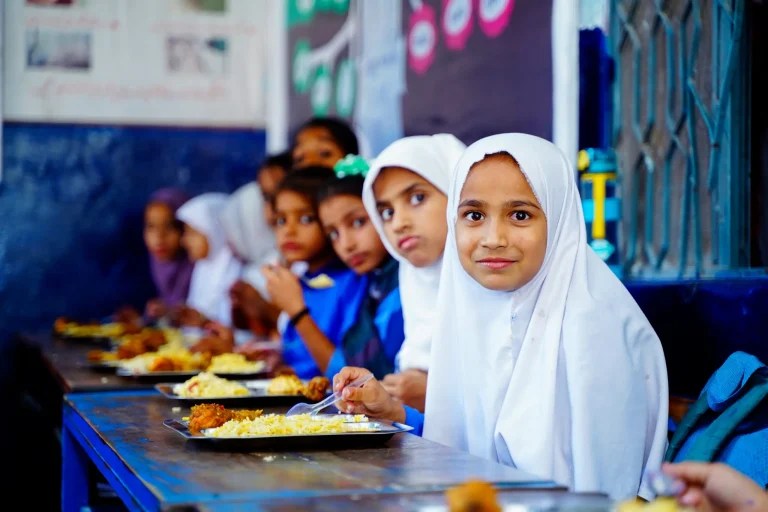
As part of a school meals programme—a welfare initiative providing free lunches to primary school children—my colleague would visit classrooms to gather students’ feedback. One day, while speaking with a young girl, they asked whether she liked the meal and encouraged her to eat well. The girl responded simply: at home, her grandmother cooked food but gave the meat portions to her brothers. She said she did not receive meat even when she wanted to.
Moved by what they heard, my colleague kept a follow-up with this student. On the day school meals had meat on the menu, they went to the girl student to see if she had eaten well, expecting her to relish it. To their surprise, she left the larger meat portion untouched and kept it in her lunchbox. When asked why she was not eating it, she replied that she was saving it for her brother at home.
In that small gesture—quiet, unquestioned, and deeply sincere—an entire social order became visible. Gender was not being taught through a lesson plan, but through distribution. The girl-child had already learnt to translate inequality into care, and deprivation into virtue. Her hunger was not merely denied; it was disciplined, redirected, and made morally meaningful as sacrifice.
My colleague described feeling shaken—not only by the injustice of the arrangement, but by its normality. The child did not describe it as unfair. She stated it as fact. I remember they shared this incident with choked throat and teary eyes, and left me in a similar state. This is how gendered power often works: it is absorbed early, rehearsed daily, and rendered ordinary enough that it no longer appears as violence, only as tradition, norm, and things we do.

Hidden Curriculum in Schools
The story also reveals something about schools as spaces of encounter. Educational institutions are often imagined as neutral sites of learning, buffered from the private sphere. Yet schools repeatedly become thresholds where the broader inequalities of society surface—sometimes in the most mundane places: a lunchbox, an essay, a sentence, a drawing, or even a child’s hesitation. In such moments, leadership is not simply managerial. It becomes interpretive and ethical: a practice of noticing what is usually hidden, and deciding what forms of interruption are possible without humiliating the child, destabilising trust, or reproducing harm.
Gender stereotypes are learned early and have been transgressed historically. In this story, the girl is being formed as a subject who willingly disappears from her plate; she learns goodness through diminishment, love through giving away, and belonging through self-erasure. The brother, even in absence, is produced as the rightful recipient, the heir, the future of the family. The most unsettling insight is this: gendered injustice often hides not in what is done harshly, but in what is done lovingly. Sometimes, it dresses itself as care. It calls itself virtue. It passes from generation to generation, not only through violence, but through devotion.
The school principals are positioned not only as leaders. managers and administrators, but as a witness to structural inequality and a participant in the ethical labour of responses. If schools are among the few public spaces children inhabit daily, what responsibilities do educators carry when such hidden curricula surface?

Connection with the broader picture: Why the lunchbox is not “just a lunchbox”
What happened in this case is not simply a lesson about one child’s generosity; it is a glimpse into a wider pattern. A CARE USA report (2022) argues that gender inequality and food insecurity are tightly linked at national and global levels, and that women consistently have less food than men across regions. It notes that, by 2021, there were 150 million more women than men experiencing food insecurity and that the gap is widening. Even when entire households are under strain, the burdens often fall unevenly: women are more likely to eat smaller portions, skip meals, or shift to lower-quality food.
Seen alongside this evidence, the girl saving the meat for her brother reads less as an individual choice and more as the early making of a gendered subject: she has already learnt, through everyday distribution, whose hunger counts most. This is how gendered injustice often works—quietly, through routine, disguised as normality. The report also highlights how gender and food security are often treated as separate “sectors,” leaving gendered hunger under-measured and under-addressed. This is where educational leadership becomes ethically consequential. Schools are the sites of visibility where teachers and leaders notice the hidden curriculum of gender and have the opportunity to respond with small, careful interruptions that expand what equality can feel like in a child’s daily life.
Labyrinth of Gendering
In Kafka’s labyrinth, the danger is not only losing one’s way; it is mistaking the maze for home. Stories like this remind us that gendered inequality is often sustained through ordinary routes—so familiar they appear natural. Yet moments of recognition can become small openings: a pause, a question, a refusal to accept “this is how it is”.
If the politics of gender is a labyrinth, then educational leadership, at its most humane, may be one practice of holding a light, not to claim easy exits, but to help the unseen become visible, and to make room for different ways of living together.
Reference
Selva, M., & Janoch, E. (2022, July). Food security and gender equality: A synergistic understudied symphony (Report). CARE USA.
Provocation as Invitation
A lunchbox opens
and a world opens with it.A child saves the best bite
for someone else’s hunger,
as if her own
was never meant to speak.In the maze of ordinary love,
girls learn to shrink
into virtue.But listen—
even a small refusal
to call this normal
is a thread.And threads,
patiently held,
can lead us
out.-Saadia, March 2026
Author’s Note:
For ethical and privacy reasons, the names of individuals mentioned in this narrative have been anonymised, and specific details regarding departmental structures, policies, and institutional affiliations have been withheld. While the story is drawn from real events and experiences, identifying particulars have been deliberately omitted to safeguard the dignity and privacy of all involved. I believe that the truth of this encounter does not rest in names, locations, or dates—but in the phenomenon it reveals. Acts of exclusion and moments of resistance within institutional systems are universally recognisable, and it is in that shared understanding that this story finds its resonance.
to be continued…


Leave a Reply